
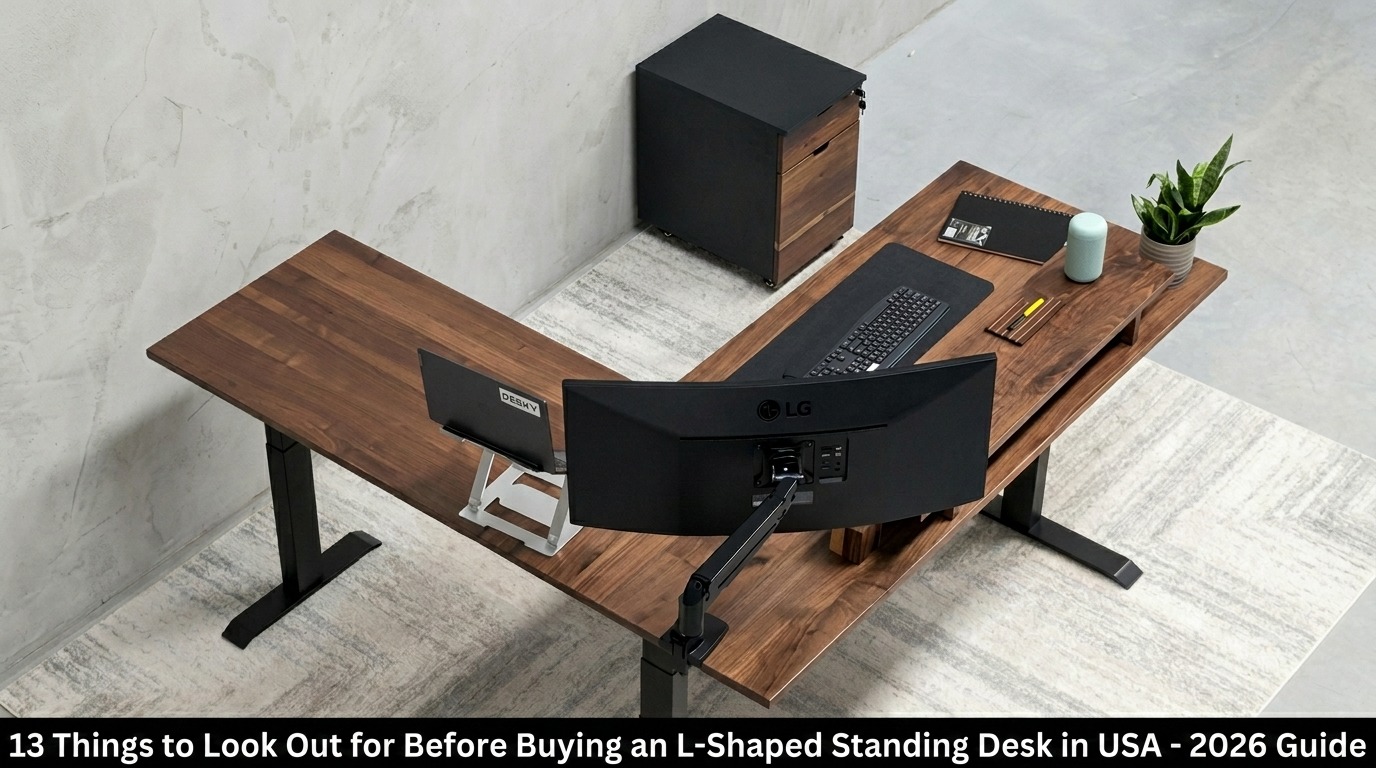
Before buying an L-shaped standing desk, check these 13 things: surface dimensions, motor type, weight capacity, stability certification, height range, frame construction, surface material, control panel features, warranty terms, US shipping, assembly support, return policy, and brand reputation. Most buyers skip at least four of them.
The Desky L-Shape Laminate Sit Stand Desk is the benchmark worth measuring every option against.
1. Surface Dimensions
L-shaped desk listings frequently advertise only the longest surface measurement. Both leg lengths must appear in the product spec sheet, because the return depth determines whether the desk actually fits your corner and how useful the secondary surface is for real work.
Measure your wall corner before ordering. A desk listed as “70 inches” may carry a 24-inch return, which places your secondary monitor outside ergonomic reach.
2. Motor Type
A single motor pulling an asymmetric L-shaped surface creates uneven lift and torque stress at the center frame joint [1]. Dual motors are the minimum standard for a stable sit-stand L-desk, distributing lift across two points rather than one.
Triple motor systems extend this by lifting from three contact points simultaneously, one per leg. The Desky L-Shape Laminate Sit Stand Desk uses a triple-motor system so that all three legs rise simultaneously, eliminating the frame-joint strain that single and dual-motor L-desks accumulate over time.
3. Weight Capacity
Manufacturers frequently publish peak load ratings rather than sustained operational capacity. Peak figures reflect a momentary maximum during factory testing, not what the desk can safely hold for eight hours of daily use.
Calculate your real equipment weight before shopping: dual monitors at 15 to 30 lbs each, monitor arms, a desktop tower, speakers, and peripherals add up quickly. For multi-monitor setups, a sustained capacity of 300 lbs or more is a practical minimum [2]. The Desky L-shape carries 440.9 lbs of sustained capacity.
4. Stability
L-shaped desks carry asymmetric loads across two surfaces, which makes stability harder to achieve than on a straight desk. Third-party certifications like BIFMA and TÜV Rheinland put frames through standardized lateral force and cycle testing that brand claims alone cannot replicate [3].
Check whether the joint connecting the two desk surfaces is tested independently. That joint is the primary structural failure point on lower-quality L-shaped builds and is rarely disclosed in standard listings.
5. Height Range
Maximum height receives most of the marketing attention, but minimum sit height matters equally for shorter users. A desk that bottoms out at 29 inches places shorter users in a raised, shoulder-straining seated posture that undermines the health benefit of adjustability entirely [4].
Look for a minimum height of 24 inches or lower, paired with a maximum that clears your standing elbow height by at least two inches. The Desky L-shape achieves a 23.6-inch to 49.2-inch range on three-stage telescopic legs.
6. Frame Construction
Steel frame is a marketing descriptor that covers a wide range of material quality. Cold-rolled steel carries significantly higher tensile strength and weld integrity than lower-grade alternatives, which matters when the frame flexes repeatedly under dynamic load over years of daily use [5].
A credible listing discloses steel gauge or references frame certifications like BIFMA, UL, CSA, or TÜV Rheinland. Vague language like “heavy-duty steel frame” with no further specification is a signal to ask more questions before committing.
7. Surface Material
Desktop thickness directly affects how a surface performs under monitor arm pressure and how it transmits vibration during height transitions. Thinner tops flex, develop uneven surfaces over time, and amplify desk movement in ways that become obvious only after months of use.
A 1-inch desktop is the current market-leading thickness for sit-stand desks in 2026. The Desky L-Shape Laminate Sit Stand Desk ships with a 1-inch surface rated zero-formaldehyde and zero-VOC, which matters in enclosed home offices with limited airflow.
8. Control Panel
A two-preset controller functions but limits the desk’s usefulness in shared home offices or in ergonomic workflows that require alternating sit-stand intervals at specific heights. Four or more saved height presets allow different users or task configurations to switch positions without reprogramming every session.
App integration adds measurable ergonomic value. Research shows that sit-stand reminder prompts significantly improve actual standing time among desk workers compared to desks without reminders [6]. Desky’s Bluetooth controls include app access, Siri compatibility, sit-stand reminders, and usage tracking as standard features.
9. Warranty Terms
Warranty language determines your actual protection more directly than the number of years on the label. A “limited warranty” with no public documentation is not meaningful consumer protection when a motor fails 20 months after purchase.
Full warranty terms should be available on the brand’s website before you place your order. Check three things: what components are covered, the duration per component, and the claim process.
Desky offers a 10-year warranty with publicly documented terms, among the longest available for an L-shaped sit-stand desk in the US market.
10. US Shipping
L-shaped standing desks arrive in packaging weighing 150 to 250 lbs, making the fulfillment origin a meaningful variable in transit risk. Desks shipped from overseas warehouses carry higher transit damage rates, longer delivery windows, and return logistics that can cost more in fees than the original price discount justified.
Confirm before ordering whether the brand holds US warehouse stock. US fulfillment also means faster access to replacement parts and support response when something minor needs addressing post-assembly.
11. Assembly
L-shaped standing desks generally require two to three hours of assembly, and the joint connecting the two surfaces is where most errors and structural issues occur during the build process [7]. A brand that provides a video assembly guide reduces build errors significantly compared to one that supplies only a printed diagram.
Check the brand’s YouTube channel before purchasing. Desky provides step-by-step video assembly guides and offers customer support throughout the process for US buyers.
12. Return Policy
Returning an assembled L-shaped standing desk is a logistically complicated process. Many budget brands require original packaging, which most buyers discard after assembly, and charge repackaging or restocking fees of $150 to $300.
Confirm the return policy in writing before ordering: whether original packaging is required, the length of the return window, and who covers return freight. A free return window with no repackaging requirement is the benchmark to hold brands to.
13. Brand Reputation
Brand reputation for standing desks is most reliably measured through independent community sources rather than product listings or branded testimonials. Verified Amazon reviews with purchase history, independent editorial coverage, and active communities on forums like r/homeoffice provide the clearest picture of long-term ownership experience.
A brand with no community presence or where most positive reviews lack verified purchase labels warrants caution. Desky is reviewed by TechRadar, featured by Tom’s Guide, and carries an active owner community across North America, providing a verifiable track record of support quality and build longevity.
Quick Reference: 13-Point Pre-Purchase Checklist
| # | What to Check | Green Flag | Red Flag |
| 1 | Surface dimensions | Both leg lengths disclosed | Only longest leg advertised |
| 2 | Motor type | Dual motor confirmed | Single motor on L-shape |
| 3 | Weight capacity | Verified sustained capacity | Unverified peak rating only |
| 4 | Stability | Third-party wobble testing | Brand claims only |
| 5 | Height range | Min AND max disclosed | Max height only advertised |
| 6 | Frame construction | Steel gauge specified | Vague “steel frame” claim |
| 7 | Surface material | Material + thickness specified | “Premium surface” with no specs |
| 8 | Control panel | 4+ presets, app integration | 2 presets, no smart features |
| 9 | Warranty terms | Full document publicly available | Vague or buried warranty info |
| 10 | US shipping | Confirmed US warehouse | No disclosed fulfillment location |
| 11 | Assembly | Video guide available | No assembly time estimate |
| 12 | Return policy | Free returns, trial period | Repackaging required, no trial |
| 13 | Brand reputation | Active community, verifiable support | No community presence, incentivized reviews |
The 2026 US Market Landscape: Context for Smarter Buying
The L-shaped standing desk market has added more options at every price tier since 2020, but that volume has created space for quality shortcuts and specification inflation that did not exist when the field was smaller.
- Budget tier ($400–$700): Price compression has produced a crowded field where many desks share the same OEM factory frames sold under different brand names. Reliable rebrand signals include identical physical specs under multiple model names, no proprietary assembly documentation, and customer service routing to a generic overseas address.
- Premium tier ($1,000+): The field has consolidated around fewer but more differentiated brands. Those that remain tend to offer genuine engineering differentiation, longer warranties, and domestic after-sales infrastructure worth the price difference.
- Import tariffs in 2026: Adjustments have pushed prices upward on desks manufactured overseas without US warehousing. Verify whether current pricing reflects those adjustments and whether extended transit times affect the brand’s delivery and return commitments.
- What hasn’t changed: The fundamentals still reward the same scrutiny they always have. Disclosed frame specifications, third-party stability certification, and publicly available warranty documentation remain the clearest indicators of a desk built to last well beyond its third year of daily use. Brands that publish these details openly are the ones worth buying from.
Frequently Asked Questions
What is the minimum weight capacity I should look for in an L-shaped standing desk?
For a dual-monitor home office, look for a sustained weight capacity of at least 300 lbs. If you run a desktop tower on the surface alongside monitors, arms, and peripherals, aim for 400 lbs or higher. Always verify whether the published figure represents peak or sustained operational capacity before relying on it.
How much floor space does an L-shaped standing desk require?
A standard L-shaped standing desk requires a corner area of approximately 60 by 60 inches for both surfaces, plus chair clearance for the desk to rise unobstructed. Larger models with extended return surfaces may require 70 by 70 inches or more. Measure the corner and check clearance above the desk before ordering.
Is a triple motor system actually better than dual motors on an L-shaped desk?
For asymmetric L-shaped surfaces, yes. A triple motor system lifts from three contact points rather than two, distributing weight more evenly and reducing torque stress at the center frame joint. The difference is most noticeable under heavier loads and at the upper end of the height range, where dual-motor asymmetric designs tend to show more lateral movement.
Does the Desky L-Shape Laminate Sit Stand Desk ship to the US?
Yes. The Desky L-Shape Laminate Sit Stand Desk is available in the US through Amazon. It includes a 10-year warranty and Bluetooth smart controls with app and Siri voice compatibility as standard features.
What is the weight capacity of the Desky L-Shape Laminate Sit Stand Desk?
The Desky L-Shape Sit Stand Desk has a 440.9 lb (200 kg) sustained weight capacity and is powered by a triple-motor system. This exceeds most dual-motor competitors in the same category, which typically weighs between 275 and 400 lbs, and makes it one of the higher-capacity L-shaped sit-stand desks available to US buyers in 2026.
Bottom Line
Most L-shaped standing desk purchases go wrong at the spec sheet, not at the desk itself. Buyers focus on price and surface area, then discover the motor is underpowered, the warranty is buried, or the return costs more than the discount was worth.
Run all 13 checks before committing. If a listing cannot answer them, that is the answer.
The Desky L-Shape Laminate Sit Stand Desk passes every one: triple-motor lift, 440.9 lb capacity, 23.6 to 49.2-inch range, 1-inch zero-VOC surface, integrated cable management, app and Siri controls, and a 10-year warranty with publicly documented terms. It is the clearest benchmark in its category for US buyers in 2026.
References
[1] Occupational Safety and Health Administration. (2024). Computer workstations eTool: Components and workstation setup. U.S. Department of Labor. https://www.osha.gov/etools/computer-workstations
[2] Cornell University Ergonomics Web. (2023). Workstation design recommendations. Cornell Human Factors and Ergonomics Research Group. https://ergo.human.cornell.edu/
[3] BIFMA International. (2024). BIFMA X5.5: Desk products standard. Business and Institutional Furniture Manufacturers Association. https://www.bifma.org/page/standards
[4] National Institute for Occupational Safety and Health. (2023). Ergonomic guidelines for manual material handling. Centers for Disease Control and Prevention. https://www.cdc.gov/niosh/topics/ergonomics/
[5] American Iron and Steel Institute. (2023). Steel products: Cold-rolled sheet and strip specifications. https://www.steel.org/
[6] Shrestha, N., Kukkonen-Harjula, K. T., Verbeek, J. H., Ijaz, S., Hermans, V., & Bhaumik, S. (2018). Workplace interventions for reducing sitting at work. Cochrane Database of Systematic Reviews, 2018(6). https://doi.org/10.1002/14651858.CD010912.pub4
[7] Mayo Clinic. (2024). Office ergonomics: Your how-to guide. Mayo Foundation for Medical Education and Research. https://www.mayoclinic.org/healthy-lifestyle/adult-health/in-depth/office-ergonomics/art-20046169